


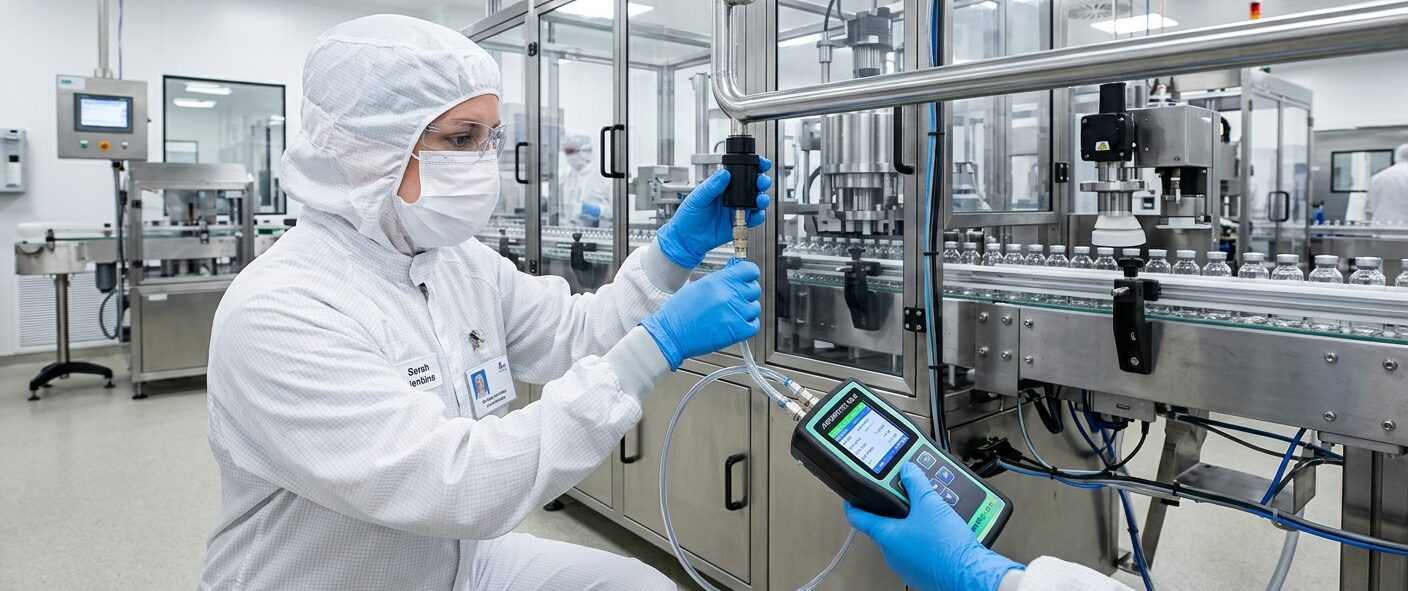
Across Cambridge city and the wider East Anglia region, the pharmaceutical and life sciences sector forms a crucial part of the local economy. For facilities operating in these highly regulated environments, compressed air is far more than an energy utility – it is a direct or indirect part of the manufacturing process,requiring careful design, control and monitoring.
Understanding ISO 8573-1, the international standard for compressed air purity, is vital for plant quality assurance (QA) teams and maintenance engineers looking to maintain compliance, protect consumer safety, and pass audit inspections with confidence.
What Is ISO 8573-1?
ISO 8573 is the globally recognised family of standards governing compressed air quality. Part 1 (ISO 8573-1:2010) specifically defines purity classes based on three primary categories of contaminants found in industrial compressed air:
- Particles: Solid contamination such as dust, pipe scale, and micro-particles.
- Water: Moisture, water vapour, and pressure dew point limits (which prevent microbial growth).
- Oil: Liquid oil, aerosol oil mist, and hydrocarbon vapours.
For QA directors, facility managers, and validation engineers, understanding how ISO 8573-1 intersects with GMP (Good Manufacturing Practice) and ISO 14644 cleanroom standards is essential for maintaining strict process integrity.
Understanding ISO 8573-1 Purity Classes for Life Sciences
In life sciences environments, compressed air purity specifications generally fall into two primary applications:
1. Direct Product Contact & Sterile Processing Air
- Target Purity Class: ISO 8573-1 Class 1:2:1 or Class 0
- Particle Control (Class 1): Essential for preventing sub-micron particulate contamination in vials, active ingredients, and injectable products.
- Moisture & Dew Point Control (Class 2): Requires a pressure dew point (PDP) of -40°C or colder. Inhibiting microbial viability; dry environments prevent bacteria, spores, and fungi from surviving or multiplying within air distribution networks.
- Oil Vapor Control (Class 1 / Class 0): Limits total oil content (including organic hydrocarbons) to < 0.01 mg/m³ (Class 1) or stricter vendor-certified limits (Class 0), preventing chemical alteration of drug formulations.
2. Cleanroom Actuation & Indirect Process Air
- Target Purity Class: ISO 8573-1 Class 2:4:2 (or aligned with the surrounding cleanroom ISO class)
- Process Risk: Pneumatic exhaust air discharged from solenoid valves and actuators inside ISO Class 5 to ISO Class 8 cleanrooms can introduce oil mists and moisture into the ambient environment, compromising cleanroom differential pressure and cleanliness levels defined under ISO 14644-1.
The Cleanroom Connection: Integrating Compressed Air with GMP Audits
Regulatory bodies – including the MHRA and FDA (cGMP guidelines) – treat process compressed air as a source of potential cross-contamination. During an audit, inspectors regularly examine:
- Microbiological Validation: Demonstrating that non-viable particle filtration (0.2 µm / 0.01 µm sterile air filters) effectively blocks viable microorganisms at point of use.
- Desiccant Dryer Redundancy: Ensuring continuous supply of ultra-dry air without dew point spikes during dryer desiccant switching cycles.
- Distribution System Materials: Verification that hygienic, smooth-bore stainless steel 316L pipework (or high-purity aluminum with appropriate seals) is deployed downstream of final filtration to eliminate particulate shedding and bio-film accumulation.
Oil-Free Compressors vs. Point-of-Use Validation: The “Class 0” Misconception
Installing an “oil-free” air compressor is a critical baseline step, but it does not automatically guarantee ISO 8573-1 Class 0 air at the point of application.
An oil-free air compressor only guarantees that no oil is introduced inside the compression chamber. It does not remove background environmental pollutants, moisture, or volatile organic compounds (VOCs) present in the ambient intake air.
To achieve true GMP-compliant process air, facilities rely on a fully validated air-treatment train tailored to their exact purity requirements. Cambs Compressors designs, installs, and maintains end-to-end air treatment systems built around industry-leading technologies.
- Oil Elimination at the Source: We supply and service certified Class 0 oil-free compressors (including premium BOGE models) as well as retrofit systems which convert residual oil vapors into harmless carbon dioxide and water.
- Precision Humidity & Dew Point Control: To prevent microbial growth, we integrate high-efficiency dryer systems. These systems deliver stable, monitored pressure dew points between -40°C and -70°C, backed by optional continuous dew point logging and alarm installation services.
- Point-of-Use Sterile Filtration: Cambs Compressors provides medical and pharma-grade micro-filtration and sterile air filter assemblies capable of full sterilisation cycles. We also manage ongoing filter integrity testing, element replacements, and validation support to keep your cleanroom drops fully compliant.
How Cambs Compressors Supports East Anglia’s Biotech & Pharmaceutical Facilities
Cambs Compressors provides complete validation support, routine monitoring, and turnkey system installation designed to meet the rigorous demands of Cambridgeshire’s life sciences sector. Contact the specialist team today on 0800 0029 601 or request a site compliance audit to review your air treatment infrastructure.