


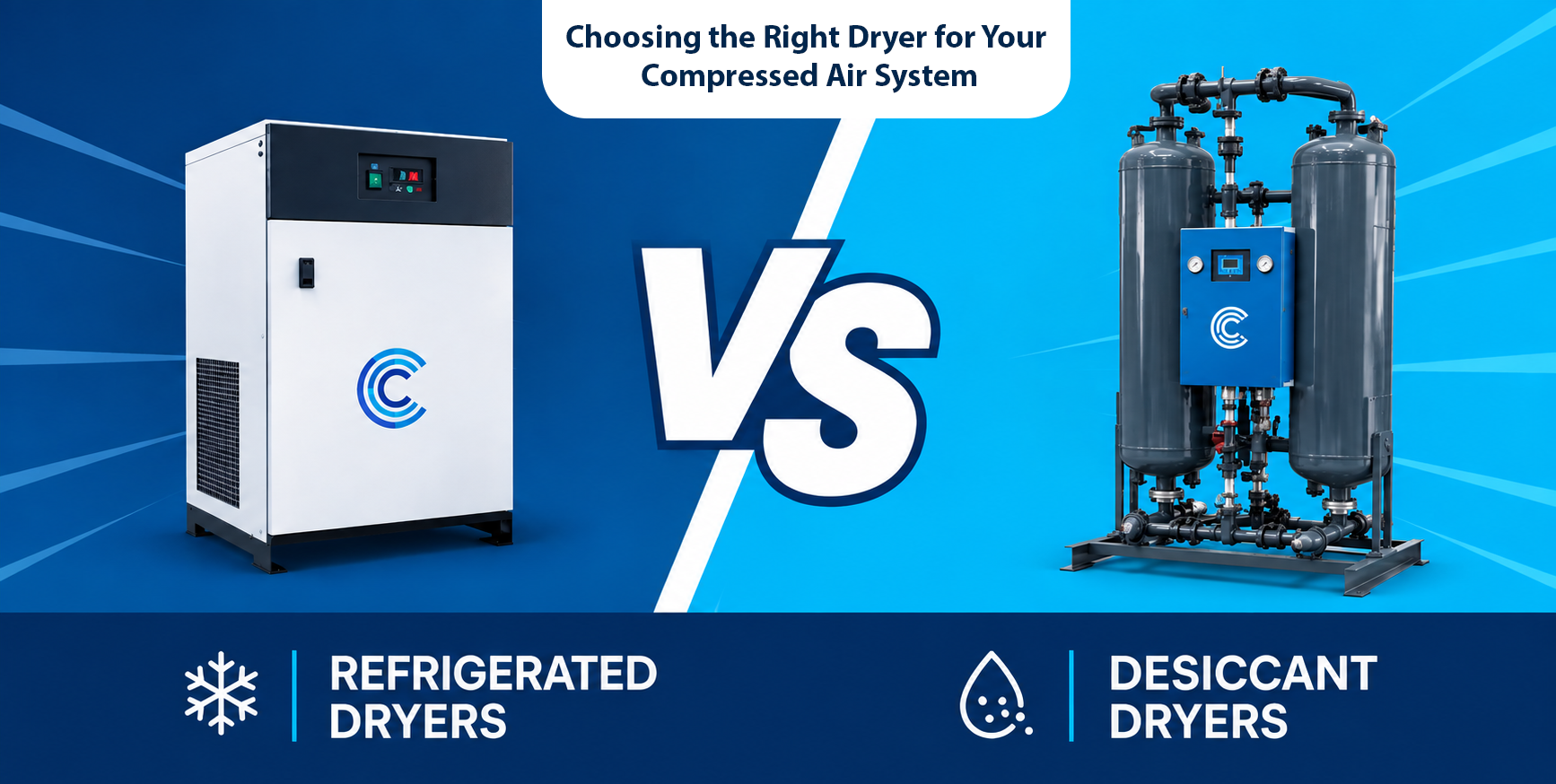
Choosing between a refrigerated air dryer and a desiccant air dryer is one of the most critical equipment decisions you will make for your compressed air system. Picking the wrong setup can lead to high running costs or unexpected production downtime.
When you compress ambient air, you also squeeze out massive amounts of water vapour. Left unchecked, that moisture quickly travels down your pipework, ruining pneumatic tools and contaminating finished products.
Here is everything you need to know to specify the right dryer for your system.
Why Compressed Air Needs Drying
Air compressors draw in ambient atmospheric air, which always contains invisible water vapour. As air is compressed into a smaller volume, its relative humidity hits 100%.
When the compressed air cools down inside your distribution pipework, that vapour condenses into liquid water. Liquid moisture causes corrosion in steel pipes and flushes away lubricant inside expensive air tools.
Excess water also creates ideal breeding grounds for bacteria and mold inside your lines.
Pressure Dew Point Explained
Before comparing dryer types, you must understand Pressure Dew Point (PDP). PDP is the temperature at which water vapour in compressed air condenses into liquid at operating pressure.
- A lower PDP means drier air.
- A higher PDP means moisture will condense at warmer temperatures.
If your pipework stays indoors at 20°C, a PDP of +3°C ensures no condensation forms. However, if your pipework runs outside during a freezing UK winter, your PDP must drop well below zero to prevent freezing pipes.
Refrigerated Air Dryers: The General Workhorse
Refrigerated dryers operate much like a home fridge. They cool the incoming compressed air down to around +3°C, forcing water vapour to condense into liquid droplets that drain out automatically.
Once the moisture drains, the cold air is reheated by incoming warm air before entering your plant. Reheating raises the temperature of the dried compressed air before it leaves the dryer, improving efficiency and ensuring the outlet air is above the surrounding dew point.
Key Advantages & Considerations
Refrigerated dryers carry low initial purchase costs and offer low ongoing electrical consumption. They provide reliable performance for everyday industrial tasks. Refrigerated units require very little maintenance – basic condenser cleaning along with periodic drain valve checks.
However, they cannot achieve dew points below freezing (+3°C PDP limit). Trying to push them colder can cause internal heat exchangers to ice over and block airflow completely.
Desiccant Dryers: Extreme Dryness for Sensitive Process Air
Desiccant dryers, also known as adsorption dryers, use a porous desiccant material to remove water vapour from compressed air. Common desiccant materials include activated alumina, silica gel and molecular sieve. Rather than cooling the air until moisture condenses, the process adsorbs water vapour onto the surface of the desiccant material.
These systems typically use a twin-tower design. While one tower actively dries the incoming compressed air, the secondary tower regenerates its desiccant bed using heat or a portion of dry purge air.
Key Advantages & Considerations
Desiccant dryers achieve extremely low dew points, typically down to -40°C or even -70°C PDP in extreme applications. This produces very dry compressed air, which may be required for applications where moisture could affect the product, process or equipment, or where compressed air is exposed to very low ambient temperatures..
The trade-off comes in operating costs. Regenerating the desiccant bed requires noticeable energy, either through electric heaters or by venting up to 15% of your compressed air as purge air. Desiccant dryers require more ongoing maintenance – they need regular filter element replacements and fresh desiccant beads every 3 to 5 years.
Refrigerated vs desiccant dryers: what’s the key difference?
The key difference is the level of moisture removal each technology is designed to achieve.
| Refrigerated dryer | Desiccant dryer | |
|---|---|---|
| Moisture removal | High | Very high |
| Typical application | General industrial air | Critical/dry-air applications |
| Pressure dew point | Typically around +3°C | Can be much lower -40 to -70°C |
| Energy requirements | Generally lower | Generally higher |
| System complexity | Relatively simple | More complex |
| Initial cost | Generally lower | Generally higher |
| Best suited to | General manufacturing | Applications requiring very dry air |
The exact performance of any dryer depends on its design, operating conditions, inlet temperature, ambient temperature, pressure and flow rate. Dryer selection should therefore be based on the actual requirements of the compressed air system rather than simply choosing the cheapest option.
Typical Applications by Industry
| Industry | Recommended Dryer | Typical Target ISO Class |
| General Manufacturing | Refrigerated Dryer | ISO 8573-1: Class 4 (+3°C PDP) |
| Food & Beverage | Desiccant Dryer | ISO 8573-1: Class 2 (-40°C PDP) |
| Pharmaceutical & Life Sciences | Desiccant Dryer | ISO 8573-1: Class 1 or 2 (-40°C to -70°C PDP) |
| Electronics & Laser Cutting | Desiccant Dryer | ISO 8573-1: Class 2 (-40°C PDP) |
Food & Beverage Production
Direct or indirect air contact with edible products requires zero risk of bacterial contamination. Desiccant dryers supply ultra-dry air that prevents microbial growth in food packaging lines.
Pharmaceutical & Life Sciences
Laboratory environments across Cambridgeshire demand strict adherence to ISO cleanliness standards. Desiccant technology ensures air is totally sterile and dry for delicate chemical processing.
Electronics Manufacturing
Component assembly and precision laser cutting require air free of tiny trace vapors. A desiccant dryer prevents oxidation or microscopic blemishes on delicate silicon wafers and circuit boards.
General Workshops & Assembly
For pneumatic hand tools, workshop hoists, or standard machine automation, a refrigerated dryer delivers reliable protection at a fraction of the operating cost.
How to Specify the Correct Dryer with ISO 8573-1
Specifying air drying equipment requires checking ISO 8573-1:2010, the international standard for compressed air quality.
ISO 8573-1 classifies air purity across three main contaminants:
- Solid Particles
- Water (Pressure Dew Point)
- Oil Content
To select the right model, identify the specific ISO Class your downstream machinery demands. Once your target class is set, sizing depends on maximum airflow (CFM or m³/min), minimum ambient room temperature, and inlet air temperature coming off your compressor.
Get Free Expert Guidance for Your Air System
Getting air quality right protects your production quality while keeping energy bills under control. Installing a desiccant dryer where a refrigerated unit works fine wastes electricity, while under-specifying risks costly production contamination.
Still not sure which dryer you need? Cambs Compressors provides free advice as well as complete compressed air audits, ISO purity testing, and system design tailored across Cambridgeshire and the East of England. Contact our engineering team today to review your air treatment setup.